
What If We Chose to Love the Jews?
Jewish Sacred Art as a Path Toward Peace
By: Aimee Golant Casella
Antisemitism is on the rise. Again. The horrific events of October 7th and their aftermath have torn open old wounds and exposed a surge of hatred. Jews are being slandered, misconstrued, and dehumanized. Our symbols, our values, our very humanity are under assault. College campuses erupt with protests where criticism of Israeli policy often morphs into virulent antisemitism. Social media platforms are flooded with ancient libels repackaged in contemporary language. Synagogues are forced to tighten security. Parents fear sending Jewish children to public schools. Jewish people, simply for existing, are shamed and ostracized.
As a Jewish woman, a sixth-generation metal artist, and the granddaughter of Holocaust survivors, I am intimately acquainted with this pain. It is a pain that echoes through generations. But my response to this resurgence of hatred is not silence, nor despair. My answer is creation, compassion, and collaboration. For over 30 years, I’ve created Judaica—sacred objects like mezuzahs. These small, yet significant ritual cases hold the klaf, a sacred scroll inscribed with verses from the Torah, and are affixed to the doorposts of Jewish homes. These pieces are not mere decorations; they are powerful declarations of faith, identity, and values. They proclaim: “In this home, we are grateful. We cherish life, kindness, truth, and compassion. We carry these teachings with us, as we come and as we go.” The mezuzah is more than a commandment; it is a constant reminder of our sacred responsibilities. Though only Jews are commanded to place mezuzahs on their doorposts, its essence—living a life of gratitude, awareness, care, and sacred responsibility—is universal. Anyone who passes through a doorway with intention can benefit from its silent wisdom.

This raises a fundamental question: What if the world paused to truly listen—not just with their ears, but with their hearts—to these enduring teachings? What if, instead of succumbing to hatred, people chose to trust and understand us?
A Different Way Forward
What I yearn for the world to understand is this: Jews and Judaism are not a threat. The Jewish people are diverse, woven together by a shared history, faith, and culture. At our core lies a profound reverence for life. Sharing our rituals and art can foster genuine communication and create real connection. Jewish tradition, honed over millennia, offers wisdom on navigating uncertainty, upholding our obligation to be stewards of the earth, and pursuing truth, justice, and peace. The mezuzah, in this context, is a tool for deeper understanding and daily intention.
So I ask again: What would the world look like if it chose to love the Jews?
Not uncritically. Not blindly. But with the same openness, curiosity, and empathy that are extended to other marginalized or misunderstood communities. The historical trend of hating Jews has never served humanity. It didn’t during the Spanish Inquisition, or the pogroms of Eastern Europe, or the horrors of the Holocaust. And it certainly doesn’t now. But listening, learning, and collaborating with us might just move the needle. Even a little. We, the Jewish people, have survived centuries of persecution, genocide, exile, and demonization —and still, we create. We share. We open our doors. Through art, people can look past sensationalist headlines and dehumanizing hashtags, and choose to encounter the depth of human values, and the enduring power of human wisdom in their full complexity.
A Healing Through Creation
The trauma that Jews carry is real, generational, and often tragically misunderstood. My grandfather, a survivor of the Shoah, was a precision tool and die maker. He built the machines used to make candles—a legacy of light. That spirit of creation continues to inspire my work. Right now, I’m creating two major collaborative sculptures, embodying fundamental Jewish values, and pointing toward a more peaceful future. The first is a large-scale Tree of Life sculpture, meticulously crafted from copper in collaboration with artist Lisa Rauchwerger. Commissioned for Hospice of the Valley, the sculpture offers solace and comfort to those grappling with grief and loss. While the Tree of Life is a powerful and resonant Jewish symbol, it also represents growth, resilience, and interconnectedness. The second piece, designed with my husband and fellow artist, David Casella, is a silver and copper “book” that opens into a heart, created as a retirement gift for educator Debby Arzt-Mor from the Brandeis School of San Francisco. Inside, pages bear a timeless quote from the teachings of Hillel: “Be of the disciples of Aaron—loving peace and pursuing peace, loving people and bringing them close to Torah'” (Pirkei Avot 1:12). This piece celebrates education, love, and the pursuit of peace – values central not only to Judaism, but to a just and compassionate society. These pieces represent a deeper solution: art that heals, connects people, and embodies values that transcend generations.

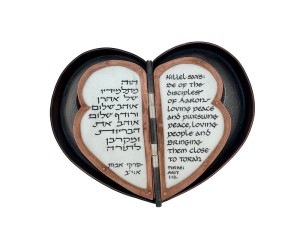
Sacred Objects as Sacred Bridges
My work builds bridges—between people, communities, and different ways of seeing the world. Sacred art softens hearts and communicates love and understanding. Ritual objects—whether mezuzahs, books, or Trees of Life—can become potent symbols of our shared humanity. If we are to be a “light unto the nations,” as the Torah teaches, then we need people willing to receive that light, to open their minds and hearts. And we need space to share our stories and traditions, without fear of prejudice, discrimination, or violence. This is my offering: metalwork shaped by ancient traditions, inspired by deep spiritual values, and forged with kindness, compassion, and the hope of peace. In a time when the world often feels shattered, may our shared humanity—our fundamental oneness—hold us together.
— Aimee Golant Casella is a sixth-generation metal artist an interfaith advocate, and the granddaughter of Holocaust survivors. Living in San Francisco, CA with her husband David and son Kaleb, she has created sacred Jewish objects for over three decades, centering her work on Jewish values, and peace.
Leave a reply