
Yesterday was Yom HaShoah—Holocaust Remembrance Day. Today marks my grandmother’s 15th yahrzeit. (The anniversary of her death.)
I’m sharing a piece written by my cousin, Adi Gozdzinski. It tells the story of my great-aunt and her family, along with my maternal grandparents’ experiences during the Holocaust and the lives they built afterward. I’ve made a few edits to highlight my grandparents and to clarify language. I’m also including a short video of my grandmother speaking about her Holocaust experience.
I’m sharing this to honor our family’s story—and the resilience, courage, and humanity that carried them through unimaginable darkness.
In difficult moments, I return to my grandmother’s words: “This too shall pass” and “Be strong.”
As I watch rising hatred and division in the world today, I feel both fear and anger. But I also feel a deep responsibility to remember, to speak, and to hold onto the truth of who we are. No one else gets to define that.
There must be a place where Jewish life is safe and can endure. At the same time, I recognize that others also hold deep, meaningful connections to that same land—and they deserve dignity and safety as well.
Remembering the past is not only about looking back—it’s about shaping how we move forward.
#HolocaustRemembrance #YomHaShoah #NeverForget
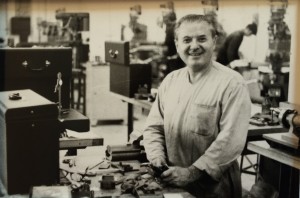
“From the Holocaust to today. The Association of Kielce and surroundings presents on this occasion information about a family from Chmielnik, a town located 27 km south of Kielce: the Godzinski family. Bluma Godzinski, single Kleinhandler, daughter of Chaya (single Becker) and Chaim Kleinhandler was born on February 13, 1919 in Chmielnik, Poland, where her father acquired a workshop for the production of machinery for the industry of candles, bicycle frames and other metal products. I think this is where I got my knack for metalwork. Just a theory!
On October 6, 1942, the Germans, with the help of an external Ukrainian unit, carried out the first deportation of Jews from Chmeilnik. That day, an operation began to remove some 13,000 Jews from their homes, who were mounted in horse-drawn carriages and later on trains, and sent to Treblinka. When the ghetto was emptied, only about 70 Jews were allowed to remain.
Bluma and her family, (with the exception of her brother Leibuch) and my grandfather and grandmother belonged to this group, who stayed behind. They seem to have lagged behind thanks to their practical knowledge in repairing machines and mechanical tools, which were used to benefit the German war effort. Leibuch and his wife fled shortly before the start of Operation October 1942 and hid on the farm of a Polish farmer. The couple were later killed by the same farmer who had given them shelter. Decapitated.
In November 1942, the Kleinhandler family was sent to the Hasag field in Kielce, where an ammunition factory was located. They were forced to make bullets for the Nazis. While in Kielce, Bluma’s mother (my great grandma) was deported to Auschwitz, where she survived until the camp was liberated by the Red Army on January 27, 1945. She had hidden under a staircase during a death march a few weeks earlier. I’m amazed– my great-grandma survived 3 years in Auschwitz and then walked home once the camp was empty!
The family men were forced to separate in Buchenwald. Chaim, Avraham and Moshe were forced to leave, and Kelman (my grandma’s brother who is my great uncle who our Kaleb is named after) was left behind. He did not survive and passed away shortly after. The others were freed by Red Army soldiers during the march. In the summer of 1945, Bluma returned to Chmielnik and settled in the place where the family was planned to meet after the war.
Bluma’s mother was there (the one who survived 3 years in Auschwitz.) Their father, Avraham (my grandpa) and Moshe came and were reunited. Bluma later married Zygmunt Gudzinski, a Holocaust survivor originally from Kielce. He survived because he was a communist-activist who had been jailed for this since 1937. He was released before the German invasion of Poland and moved with his family to Russia. At one point he was captured by the Germans and imprisoned in the Hassag field in Kielce, where he worked in the ammunition factory and there he met Bluma. He was transferred with the Kleinhandlers to Cz lerstochowa and from there to Buchenwald.
The couple got married in 1946 in Chorzów and shortly after emigrated to Argentina, where Sigmund had an uncle. The couple lived in Buenos Aires and Sigmund (Zygmunt) worked in his uncle’s factory. He later established his own independent grocery business. Bluma’s parents and his brother Moshe emigrated to Israel and opened a mechanic workshop in Jaffa.
Shortly after returning to Poland after the war, Abraham (my grandpa) instructed Josef Kleinert (uncle of Mania) to set up a branch of the ORT Group vocational school in the city of Chorzów. When he was informed a few months later that his wife Mania (my grandma) was alive and in the Feldping refugee camp near Munich, Germany, he left Poland and reunited with her. This was a miracle.
Mania (my grandma) had an uncle in New York, United States and he financed their arrival in the country. In May 1946, they set sail on the ship Marine Fleisher, the first to transport displaced Jewish people from Europe to the United States under the Truman Plan. (They soon had my aunt Henriette Kleinhandler and my mom Susan Golant. My sister Cherie Golant was the first born grandchild.)




Leave a reply